In this article
A corporate envelope is often encountered before its contents. Its job extends beyond looking consistent with the stationery: the enclosure must fit, the address must remain visible and the closure must work. Copying a letterhead onto another rectangle misses these practical requirements. Begin with the actual mailing workflow, then develop the visual layout around the enclosure, handling method and supplier’s production template.
Quick answer
Choose DL, C5 or C4 around the size, fold and thickness of the enclosure. Separate address, window, folding and adhesive zones on the supplier’s template before positioning brand elements. Approve a filled and closed sample rather than an empty flat mockup. This reveals practical failures that a polished presentation image can conceal.
What do DL, C5 and C4 mean?
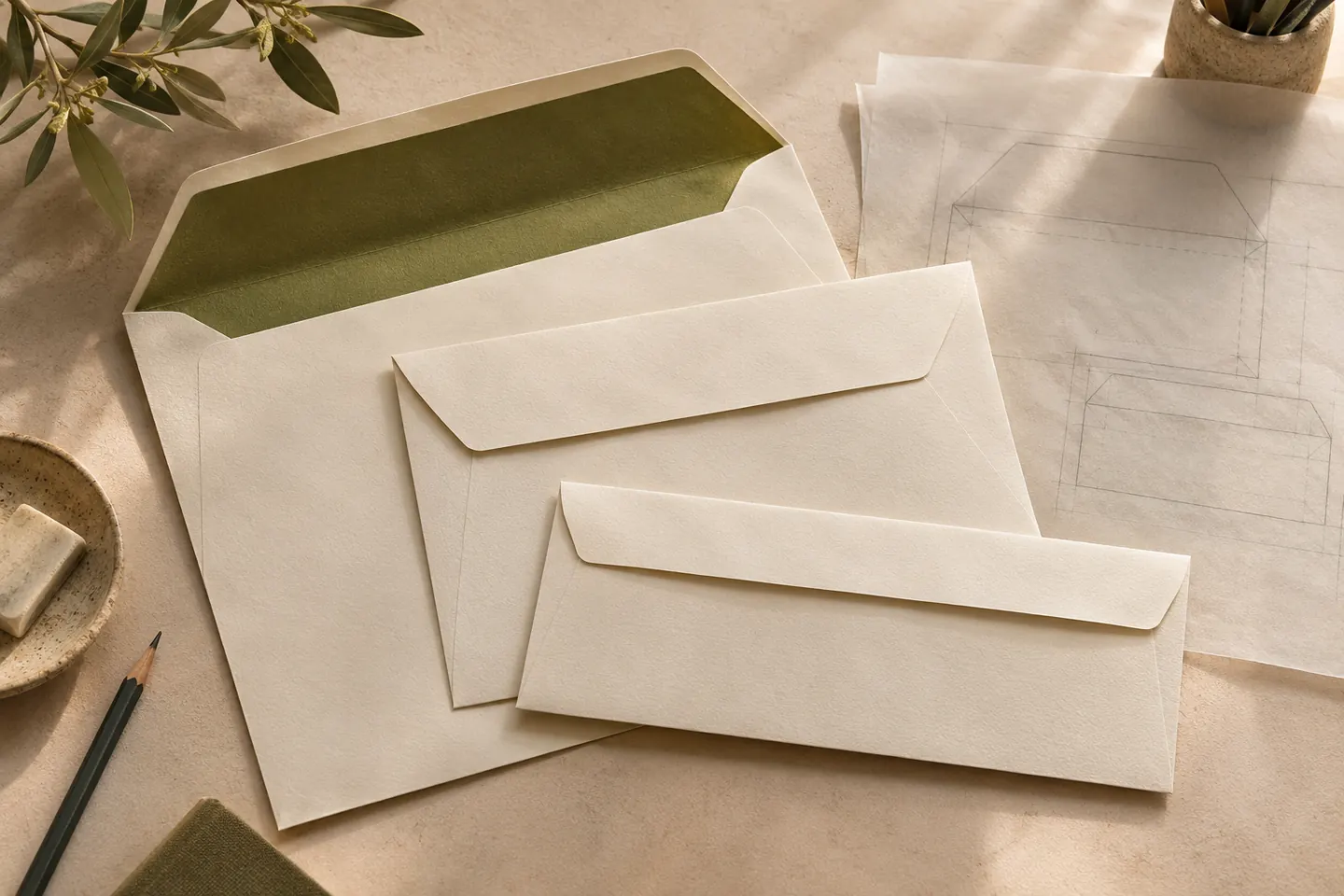
DL measures 110 × 220 mm, C5 measures 162 × 229 mm and C4 measures 229 × 324 mm. Typical uses are an A4 sheet folded into thirds, an A4 sheet folded once and an unfolded A4 sheet respectively. These are starting points, not guarantees for every enclosure. Multiple pages and thick materials require a filled sample. Confirm internal clearance, stock thickness and closure construction with the actual supplier.
Resolve the address and window first
A window envelope must be designed together with the document inside it. Moving the sheet within the envelope should not hide part of the address or expose unrelated information. Without a window, reserve enough room for handwriting, a label or variable-data printing. Clearly distinguish the sender from the recipient. Check the chosen postal operator’s current addressing requirements for the mailing type. Decorative rules must not interrupt the address or create a competing reading order.
Inspect folds and adhesive on the flat template
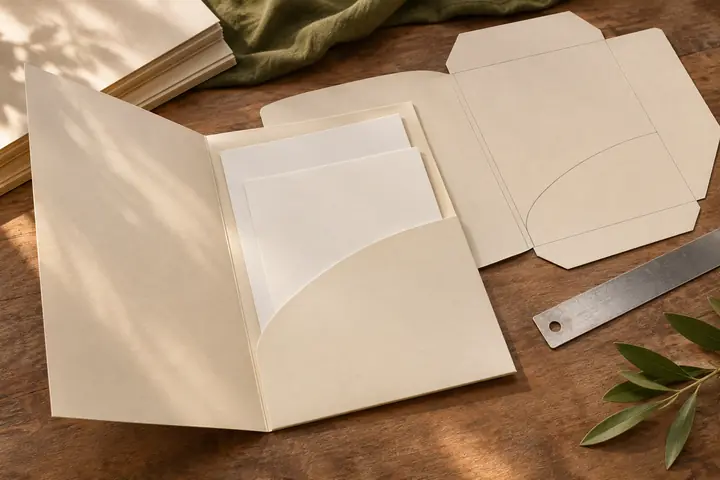
The open production template contains more than the visible front. Flaps, fold lines and adhesive zones perform different functions. When graphics cross a fold, consider the effect of manufacturing variation. Ask the supplier whether ink or finishing is permitted in adhesive areas. Read the back and front on a folded mockup rather than assuming that flat artwork will have the intended orientation. Do not alter a supplied cutting die without production approval.
Adapt the layout to the printing process
Printing onto a ready-made envelope has different constraints from printing sheets before cutting and folding. Establish whether edge-to-edge colour, dense backgrounds or special inks are supported before approving a design. Test fine contact details at their final size. A restrained two-colour layout may be easier to reproduce consistently, but the decision should follow the identity and physical samples. Compare the envelope with the letterhead under the same lighting instead of relying on separate screen previews.
Test the complete mailing scenario
For example, place the actual proposal letter, price attachment and business card into one sample. Check alignment with the window, comfortable closure and removal without damaging the contents. If branches require different return addresses, define them as controlled variable fields. Record the format, window specification, paper, print method and revision in the approval file. Maintain one current master and supplier reference so that a repeat order reproduces the approved construction.
Key takeaways
- Select the format around the enclosure rather than the logo.
- Plan address, window, folds and adhesive zones together.
- Include a filled, closed sample in production approval.
Frequently asked questions
Can one envelope serve every mailing?
A thin letter and a substantial presentation have different needs. Group common enclosures into a small set of approved formats rather than choosing an envelope independently for every mailing.
Is a window envelope more professional?
A window is a workflow choice, not a mark of higher status. It can reuse an address printed on the letter, provided movement does not expose private content or conceal the destination.
Is a digital mockup sufficient approval?
A digital mockup communicates layout but cannot establish closure, capacity or window alignment. A folded sample made from suitable material and tested with the enclosure provides more useful production evidence.