In this article
Personal taste helps when choosing a web designer, but it cannot answer every question. Behind a finished screen sit decisions about content, interaction, mobile adaptation and detail for development. A suitable designer connects those decisions to your purpose and explains the boundaries of their work. This article offers ways to assess individual practice without ranking people. It treats the choice between an individual and a team as a question of responsibility and scope, rather than an automatic hierarchy of talent.
Quick answer
Look beyond finished screens when choosing a web designer. Ask how the problem was defined, how alternatives were considered and how work was handed to development. Request examples of mobile usability, accessibility and information hierarchy. Choose between an individual and a team through required scope, communication needs and continuity arrangements.
Look for reasoning behind the style
A portfolio may have a strong visual character. Applying the same colors, animation and layout to every project may not suit your brand, however. Ask the designer to explain the user need behind an admired example. This makes the relationship between style and purpose easier to assess.
Evaluate typography, spacing and hierarchy through their contribution to understanding, rather than as fashion choices. An unreadable heading can look impressive in a presentation. Real content at realistic screen sizes provides a stronger basis for discussing the quality of decisions.
Discuss a small problem together
Imagine a service page where visitors need three facts before requesting a quote. Ask how the candidate would approach organizing them. Explore questions and reasoning rather than requesting unpaid production. A useful conversation allows the designer to identify what remains unclear in the brief.
Do not expect one universally correct solution. Some information may need a summary, while other material benefits from comparison or progressive detail. Explaining the advantages and tradeoffs of alternatives is a more useful collaboration skill than simply defending an initial idea.
Include accessibility in the discussion
Labels, focus appearance, readability and movement should not remain unspecified finishing details. Ask how these decisions are documented. W3C guidance explains that labels identify controls and should be associated with them; a contact form offers a concrete example for discussing the designer’s approach.
A visual file alone cannot prove website accessibility. The implemented interface needs review with the developer. A designer should distinguish what is specified from what must be validated in the working product. This keeps responsibilities realistic and reduces gaps between disciplines.
Inspect the development handover
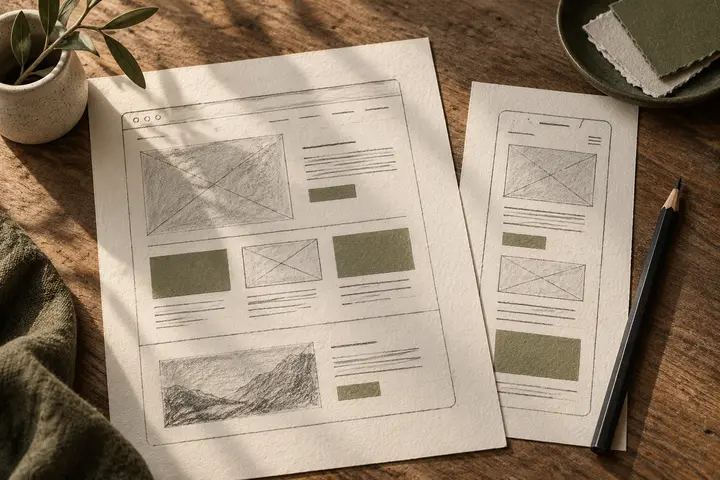
One homepage image may not be an adequate deliverable. Depending on the scope, mobile layouts, component states, long-content examples, error messages and imagery rules may be needed. Establish which are included before work begins instead of discovering missing decisions during implementation.
Consider who uses the files next. If another developer is involved, understandable structure and annotations matter. Document source files, font choices and permitted use of licensed imagery. Do not assume every third-party asset can be transferred or reused without restrictions.
Compare working arrangements fairly
An individual designer can offer direct communication. A larger team can bring multiple specialties together. Neither guarantees quality. Identify who handles writing, development, photography and maintenance, and how those people coordinate. Every activity does not necessarily need to come from one person.
Before deciding, clarify who performs the work, how feedback is collected and how questions are handled after delivery. Request the same role clarity when discussing BOCW or another provider. The suitable choice meets your requirements and makes its decisions understandable throughout the project.
Key takeaways
- Examine reasoning as carefully as visual style.
- Ask which mobile layouts and states are delivered.
- Define design, development and maintenance responsibilities separately.
Frequently asked questions
Must a designer also write code?
That depends on scope. Different people can design and implement a site. Clear responsibilities, useful handover information and ownership of working-interface checks are what matter.
Does a large following indicate a better designer?
Follower numbers do not establish project fit or delivery quality. Relevant work, a clear thought process and an appropriate working arrangement provide more direct evidence.
Is liking a portfolio style enough?
It is a starting point. Assess responses to different content and user needs, and how visual decisions translate into real mobile screens and interactive states.