In this article
A patisserie identity can appear at an everyday counter and on the table at a special celebration. The commission needs to accommodate both encounters. Cake packaging is carried and viewed from several directions, often beside personalised messages. Separating the permanent business name from changing celebration information gives the client a clearer basis for selecting the mark and specifying the templates that staff will use afterwards.
Quick answer
Explain how everyday sales and celebration orders relate when commissioning a patisserie logo. Test proposals on a closed cake box, small product label and order card. Keep personalised messages independent of the mark. Request the box arrangement, a compact label version and a card example showing which customer-specific fields may change without altering the identity.
Separate celebration wording from the business identity
The patisserie name may share a surface with birthday, congratulation or event messages. Show which wording identifies the business and which belongs to an order. If celebration services have an additional name, the client should explain its relationship with the main patisserie. Fixing one greeting around the emblem can restrict other uses. Bring the actual business name and a fictional celebration message to the discussion, avoiding personal customer information while still demonstrating realistic text lengths.
Compare the cake box when it is closed
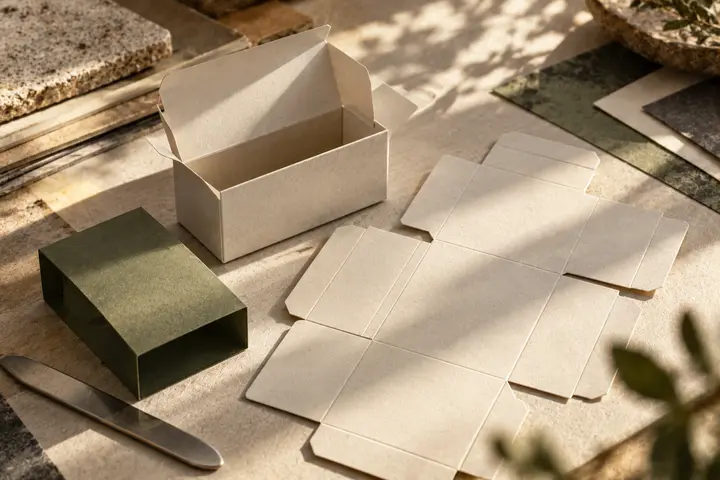
The lid, handle and closure determine the available identity area. Supply the selected box drawing and photograph rather than approving a design on an imaginary large lid. In a hypothetical patisserie using two sizes, include the smaller one. Does the logo disappear across a fold? Can the name be read when the box rests on a table? If there is a window, discuss the balance between showing the product and identifying its maker. Review open and closed states rather than assuming one attractive angle covers both.
Preserve identification on the small label
A single-portion product offers a different reading area from a large cake box. If the full name becomes crowded, discuss a compact companion rather than leaving staff to invent an abbreviation. Show it beside the full box identity and identify the lettering or form that connects them. Room for the product name and other client-approved information is part of acceptance too. This small surface is a working sales label, not merely a miniature exhibition space for the logo.
Give order details a usable card
A celebration-order card has a different purpose from a promotional leaflet. Fields identified by the patisserie team, such as the date, collection arrangement and product description, need to remain practical. Request a populated fictional example as well as the blank template. If a longer description forces the identity to shrink, revisit the layout. Explain whether the customer also receives the card. The logo commission does not redesign the ordering process; staff should tell the designer which information the existing process requires.
Specify ribbon and box outputs separately
A repeating ribbon name may need a different arrangement from the box lid. Add it explicitly to the quotation instead of assuming one packaging preview covers the whole family. Name the master logo, compact label and agreed packaging outputs clearly. The owner can approve spelling and visual direction while the supplier checks its application area. Record which layout becomes the reference when a box size changes. This gives future orders an approved starting point instead of requiring someone to reconstruct artwork from a photograph of an old box.
Key takeaways
- Keep personalised messages separate from the permanent mark.
- Review the smallest cake box in its closed state.
- List box, ribbon and order-card work as distinct outputs.
Frequently asked questions
Must a patisserie logo show a cake?
A cake image is one possibility. Consider whether it supports the full everyday offer. Strong naming can establish an identity without requiring a literal product illustration.
Should the logo change for special occasions?
Celebration graphics can occupy a separate layer. Demonstrate their relationship with the stable brand in a template rather than automatically redrawing the main mark for each event.
Is one box size enough for approval?
Review the other intended sizes too. Handles, windows and closures can limit the small box differently, even when the same overall packaging style is used.