In this article
Olives and olive oil can share a brand while their packages and product names perform different jobs. A table-olive jar may carry a long variety heading, whereas an oil bottle may offer a narrow label. Commissioning through one elegant glass bottle leaves the rest of the range untested. Establish which products the common name should connect. If a family, grove or range name is involved, decide their relationship before visual directions are developed.
Quick answer
Trial an olive and olive oil logo on at least one table product and one oil package. Separate the brand, variety and client-approved descriptions. Check recognition on a narrow bottle label and a broad tin. Approval should establish legibility independent of one package's decorative treatment, while handover should explain the shared family and range rules.
Distinguish family, grove and range names
A business may be known by a family name while products carry separate range headings. Supply every name with its role explained. A grove narrative can enrich the brand story without requiring each name to appear equally large in the logo. The owner should decide which name belongs on every product. Origin and product-quality wording should come from client-approved information. A decorative seal should not be presented as independently verifying those statements merely because it looks authoritative.
Narrow bottles, broad tins and curved jars
Usable space and viewing angles change across these formats. Establish a stable brand zone on actual packaging drawings rather than scaling every label proportionally. Review lettering disappearing around a bottle curve, handles or seams interrupting a tin panel, and product imagery affecting a jar label. Showing the same product photograph on every format is not enough. Examples using realistic label dimensions and actual product names make the consequences of each arrangement easier to discuss.
A hypothetical move from everyday products to gifting
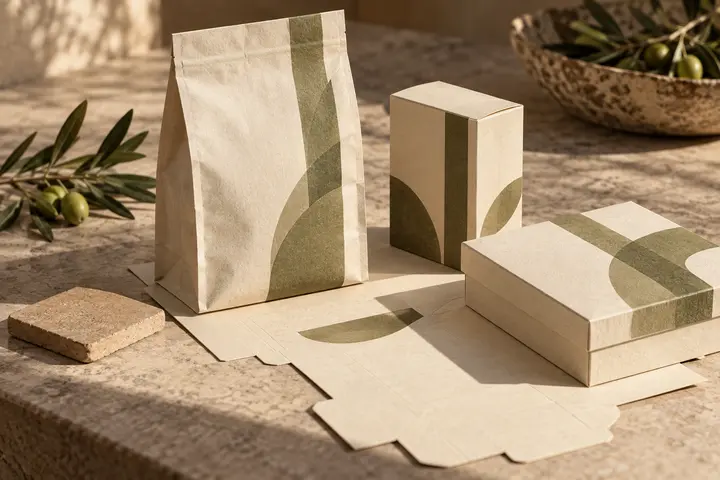
Imagine a brand combining an olive jar and a small oil bottle in one gift set. The outer box can carry the shared name while the individual items retain explicit product and variety headings. Instead of inventing a large unrelated gift crest, examine how the master signature adapts. Review the box open as well as closed. When the outer packaging is removed, both products should still connect to the same brand. This also clarifies how much of the gift presentation belongs on everyday items.
Ask concrete questions beyond the branch motif
An olive branch may be appropriate, but familiarity alone should not decide the commission. Is the name readable on the narrow label? Is a variety heading mistaken for the company name? Does line detail survive a single-colour carton mark? Request examples answering those questions. If metallic decoration is proposed, a physical material proof is more informative than screen shine. Check that the underlying identity also works without that treatment, because every sales channel may not use the same production method.
Keep seasonal communication outside the master identity
Seasonal narratives and newly approved product information can occupy changing content areas. Adding wording inside the master logo each season creates version confusion. Explain the permanent mark, range headings, label brand zones and selected gift applications separately at handover. State how many packaging formats receive completed artwork. An editable label template differs from print-ready files for every variety. Establish which areas remain protected when another product is added and which descriptions need renewed client approval.
Key takeaways
- Review a table product and an oil package together.
- Give family, range and product names an explicit hierarchy.
- Keep seasonal narratives outside the permanent logo file.
Frequently asked questions
Is an olive-branch illustration necessary?
No. Compare a branch, lettering-led signature or another approach through narrow-label legibility and the ability to connect different products.
Can tin artwork be copied directly from a bottle?
Some family rules can be shared, but placement needs reconsideration. Handles, panel seams and the length of product information may create different constraints.
Should the gift range have a separate logo?
Try a range heading under the shared brand first. Evaluate any need for another identity through examples showing the closed box and the products inside.