In this article
A moving company's identity appears between the first quotation conversation and the carton label handled on moving day. A striking vehicle signature cannot resolve an unexplained difference between the name on the proposal and the one on team clothing. Begin the design discussion with those actual encounters. If household moves, office moves and other haulage services share the business, explain which belong under one identity. Evaluate a consistent naming relationship rather than allowing the vehicle photograph to make the decision alone.
Quick answer
Use the survey form, proposal, carton label and team appearance as one acceptance scenario for a moving company identity. Separate the company name from changing customer, address and job details. Test vehicle branding with its full wording present. Deliver editable office documents separately from supplier artwork, without expecting a truck illustration to explain the complete service offer.
Carry the proposal name into moving day
Explain any difference between the familiar name used in conversation and the trading name on documents. Establish which name appears on team garments and vehicles. Creating another short name is a separate naming decision. If existing forms are already approved, show their long and short uses. Identity selection should examine how one business remains identifiable across these encounters as well as how clearly its letters read.
Populate the survey document
Customer names, addresses and service headings change in a survey or requirements form. Preserve the working fields while testing the identity. A page emptied for presentation may not represent what the office prepares each day. Use a populated specimen to examine the company heading and what happens when content runs long. The client determines form content; the designer is not being asked to prescribe how the physical move should be performed.
Treat the carton label as a small-use test
The identity and field headings should remain understandable after someone adds handwritten notes. Review the label at its intended dimensions rather than only on a large screen. Keep room descriptions or job references outside the permanent signature. Where packaging already carries another supplier's identity, show that relationship. State whether the carton example is a visualization or print-ready artwork; their appearance in a proposal does not make them equivalent deliverables.
Review all the wording on the vehicle
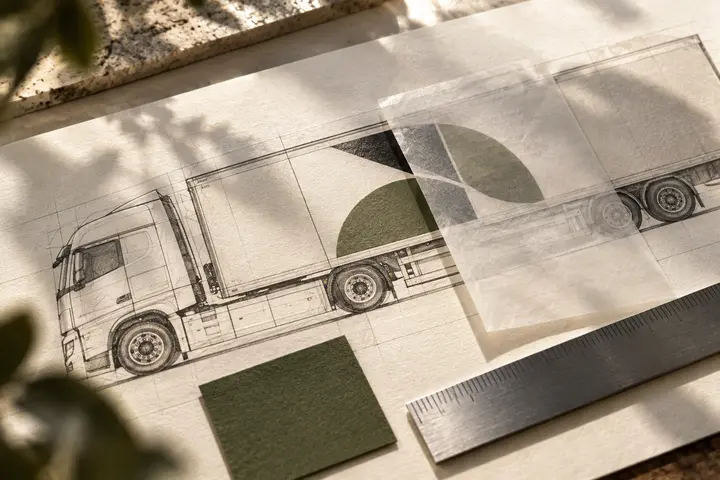
Telephone numbers, service descriptions and website details may surround the signature. Removing them to show a large symbol conceals the actual arrangement. Include rear and side views in the acceptance set. Test household and office service descriptions at their different lengths. The proposal should identify who supplies vehicle measurements and model information; a representative truck rendering is not automatically usable artwork for every vehicle in the business.
Rehearse household and office services together
A hypothetical mover adds office relocation to its household service. Compare both headings in a proposal without changing the master artwork. Discuss how a house-based symbol works in the corporate document, without assuming every firm must reach the same answer. If another subbrand is requested, demonstrate the documents in which it would appear. Service descriptions remain information approved by the client rather than claims created to explain the graphic concept.
Test the handover with the office user
Name master artwork, carton-label template, quotation form and vehicle reference separately. Editable customer fields may allow routine changes without sending every document back for redesign. Have an office user prepare a populated example. If clothing and vehicle suppliers need single-colour or small-use versions, identify them in the delivery list. Keep accepted applications linked to the main identity rather than letting each become an unexplained new signature.
Key takeaways
- Approve the naming relationship across proposals, team clothing and vehicles.
- Review carton labels at real size with writable fields populated.
- Compare vehicle visualization and measured wrap artwork as separate scope items.
Frequently asked questions
Do household and office moves need separate identities?
Test service headings under one corporate identity first. If another brand is needed, explain the customer relationship and documents it will serve before adding it to the commission.
Is a carton label just a smaller logo?
Not necessarily. Handwritten notes and restricted space may need another arrangement. Accept the identity through a populated specimen instead of judging only the isolated artwork.
Can office staff update quotations?
An editable template can allow changes to customer and job fields. Establish the intended software and fixed identity areas during commissioning so the team receives a usable document rather than a static image.