In this article
A jewellery and accessories logo may occupy a tiny product surface or a much larger presentation card. Bringing earrings, necklaces and other accessories under one name makes those scale differences significant. Explain which pieces actually carry a mark and where packaging alone identifies the brand. A monogram need not be forced onto every item. Real products, card dimensions and collection headings establish how the identity should be tested before a design direction is selected.
Quick answer
Commission the identity by connecting a compact product signature to the complete name. Compare earring cards, pouches and an actual marked piece. Keep collection headings distinct from the permanent identity. Approval should inspect reproduced detail and what remains when packaging is removed, while handover should separate product adaptations from presentation templates.
Identify which products actually carry a mark
List product groups and available identity areas. Some small pieces may not accommodate the complete name, giving packaging a greater identification role. Decisions about adding a mark should involve product teams and producers. Filling every surface is not the designer's objective. Explain the role of any personal designer name or atelier heading alongside the brand. Product information comes from the client; a visual symbol does not independently create statements about materials, quality or value.
Review earring cards with the products attached
A balanced identity on an empty card may become covered or interrupted once earrings or chains are attached. Show actual products on the card. Hanging areas, holes and information fields form its surroundings, so a plain rectangular mockup may be insufficient. Test the same header with two product sizes. If approved descriptions or contact details appear on the back, use realistic text lengths. Separating collection headings from the main signature helps the buyer understand both the product family and the overarching brand.
A hypothetical restrained and expressive collection
Imagine a brand offering small everyday pieces and a more elaborate collection. Photography and card colours can differ while the name treatment remains shared. Show cards and online category headings for both collections together. Giving each range an unrelated emblem may suggest separate ventures rather than one brand. Try range headings under a common identity first. The comparison examines whether a shared name can remain clear without flattening the distinctive character of either product group or relying entirely on matching colour.
Small signatures need actual production examples
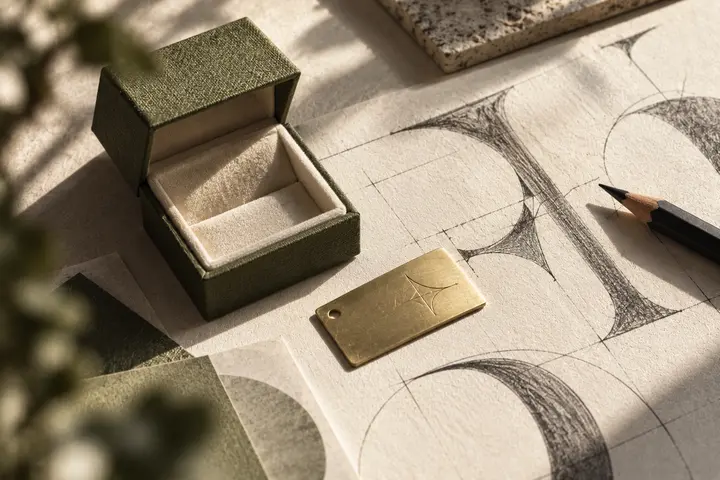
Request a sample using the producer's real surface and method. Inspect fine lines and closely spaced letters. Areas appearing open in a large screen image may close on the tiny piece. Show how the compact mark connects to the complete name on pouches and cards. Combining two initials arbitrarily does not establish that relationship. Approval should examine whether the core drawing remains distinct without decorative treatment. This is a visual reproduction check rather than verification of the item's technical or material properties.
Deliver a system for adding collections
Describe master artwork, compact signatures, card headers and pouch printing as distinct files. If completed applications for every piece are required, list products and surfaces in the quotation. A blank card template does not mean future collections are already designed. Demonstrate changing range headings while protecting identity spacing. Photography, product-copy writing and identity design are different services. Record who approves producer changes to the small signature and which physical sample guides future applications, rather than leaving the supplier to infer the intended result.
Key takeaways
- Explain packaging's identity role for unmarked products.
- Review earring cards with actual pieces attached.
- Connect compact signatures to full names on presentation surfaces.
Frequently asked questions
Must every piece carry a monogram?
No. Available space and product design may not support it. Complete naming on packaging can work alongside compact marks on selected pieces.
Should collections receive separate logos?
Try range headings beneath a shared brand first. Photography and colour can distinguish collections while the main name remains stable.
Is a small drawing sufficient for production?
A producer sample may reveal needed visual adaptations. Specify which item receives artwork and who approves the corresponding sample.