In this article
Before commissioning an e-commerce brand logo, clarify whether customers are buying the store's own products or choosing among manufacturers sold by that store. These businesses have different naming relationships. The identity may perform distinct jobs in a website header, order message and delivered parcel. Bring product categories, a representative product page and actual shipping materials to the discussion. This provides a practical scope for the lasting store identity instead of asking one mark to contain every category and future promotion.
Quick answer
For an e-commerce brand logo, explain the relationship between the store and product brands, along with the first sales channels. Compare proposals in a mobile header, order message and shipping application. Treat campaign graphics, product labels and store identity as separate deliverables. Specify editable promotional areas, the number of packaging layouts and the software the team will use to maintain any agreed templates.
Explain the store's relationship with its products
If the business develops its own products, the package name and online store name may be the same. In a multi-brand shop, the manufacturer's identity remains on the product photograph while the store signature appears above the page. Demonstrate this difference through a real page. Describe the business's role in selecting, presenting or producing goods rather than asking the designer to illustrate every category. Identify unconfirmed future categories and make any decision to base the permanent symbol on one current product deliberately.
Leave room for shopping tools in the mobile header
Search, account links and the basket share the store header. A long name that fits a generous desktop specimen may compete with these tools on mobile. Review the design at the actual header height using the full store name. If a compact symbol is proposed, decide where people can read the complete name. When website layout changes are outside the commission, request a trial within the existing arrangement; a logo presentation should not imply that the entire shopping experience has been redesigned.
Buy the right space on the parcel
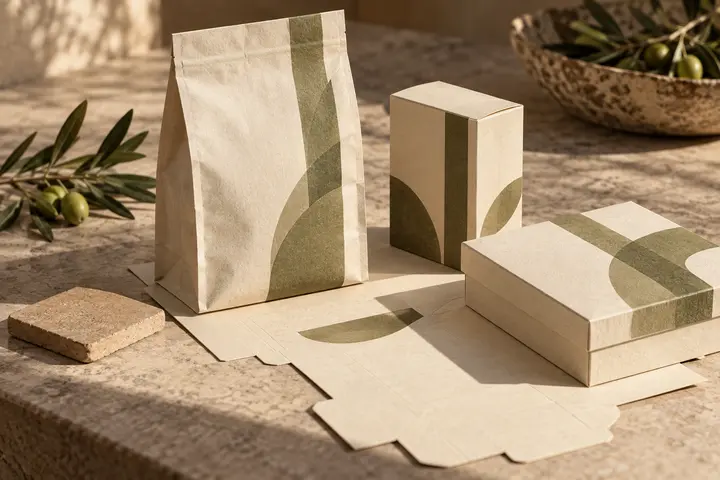
A shipping box, tape strip, label and thank-you card are different applications. Identify which will be produced initially and who will supply them. A hypothetical home accessories store may use several box sizes, so the same identity area needs to be reviewed on the smaller package too. Instead of placing the logo where a carrier label will cover it, compare positions on an actual parcel photograph. Product packaging work, if required, needs a separate description from the shipping box application.
Keep promotional messages outside the permanent mark
Discount percentages, seasonal headings and delivery offers are changing information. Manage them in campaign areas rather than making them part of the master identity. If the marketing team needs templates, request specimens with short and long headings. When a larger promotional message squeezes the product image or store name, reconsider the layout. The business should supply approved selling statements; the designer should not invent prices, advantages or delivery promises simply to complete an attractive promotional presentation.
Connect order messages with the physical handover
Look for a clear relationship between the store name in an email and the parcel a customer receives. Count order confirmations, return information cards and social profile applications in the delivery list. The content team should not need to alter master logo artwork to create another campaign. At acceptance, replace the product and heading in a sample template and inspect whether the mark keeps its proportions. Distinguish editable layouts from final image exports so the next marketing task begins from the appropriate file.
Key takeaways
- Show the relationship between store and product brands on a real page.
- Test identity space alongside mobile search and basket tools.
- Count shipping, product packaging and campaign graphics separately.
Frequently asked questions
Does every product category need another logo?
First assess a shared store hierarchy. If a category will become an independent brand, explain its separate sales and naming needs in the brief.
Is a shipping box included in the logo price?
A box mockup does not establish that production artwork is included. State sizes, application counts and the actual production files to be delivered.
Can we change the logo during a sale?
Promotional decoration can be built as a separate layer. Define which identity elements remain fixed and show how temporary additions are removed from the template.