In this article
A cosmetics logo rarely appears alone. Product names, ranges and client-approved descriptions occupy the same packaging. The commission should therefore begin with the actual surfaces in the first product family, alongside the desired brand character. Understanding how a small tube and a larger carton will share an identity allows the client to assess the relationship between visual direction and packaging layout before making a final selection.
Quick answer
Supply the master brand, range names and variable product names separately for a cosmetics-logo commission. Test proposals on the smallest tube, a jar lid and a carton front. The client should provide packaging drawings and approved wording. Handover must demonstrate small-surface use and product-family hierarchy, with the scope stating which packaging applications are included.
Turn the launch list into an information hierarchy
List the first products with their names and packaging types. Explain whether the brand or range name should lead. Incorporating a product description into the logo can force a new drawing for every variation. Supply approved product wording as separate content that the designer can organise, rather than asking the designer to invent characteristics. Flag provisional text explicitly so an illustrative placeholder does not accidentally become final packaging copy.
Include the smallest tube in the decision
A successful large carton does not establish performance on a narrow tube. Share the supplier’s print area and closure zone. Examine line breaks and the position of the product name at actual size. If proportional reduction is insufficient, discuss a compact version that clearly preserves the master identity’s structure. Review the flat application drawing as well as an attractive photograph; an angled render can conceal crowding near an edge. The client should know which tube example established acceptance, rather than approving an unspecified small-use claim.
Give the jar lid its own role
A round lid can be an appealing place for a symbol, but it should still connect with the full brand. In a hypothetical range, the lid carries a compact mark and the side label carries the complete name. Inspect the surfaces together and separately. What name appears when the product is photographed from above? If initials are used, demonstrate their relationship with the lettering on the carton. Do not assume the lid arrangement will resolve itself later if it was excluded from the commissioned applications.
Differentiate ranges without changing the master mark
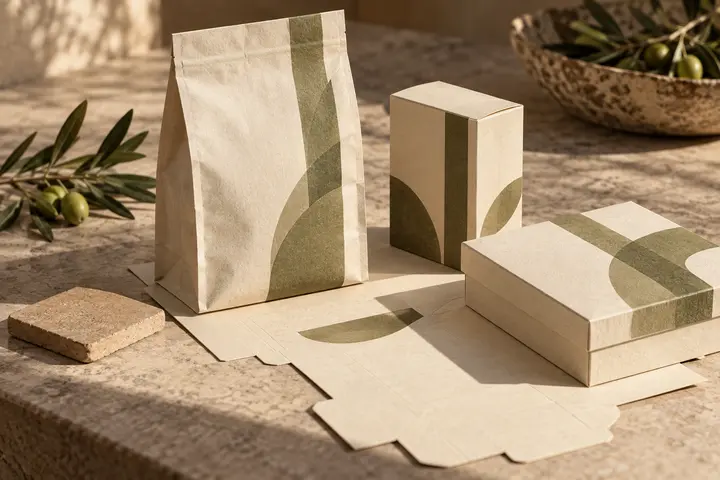
Colour or information bands can separate ranges while the principal identity stays constant. Request three packages side by side and inspect whether the brand area retains its position and proportions. A shelf-like view is useful, but also examine each package alone. If the family is coherent yet the individual products are difficult to distinguish, reconsider the variable information arrangement before commissioning separate logos. The purpose of the trial is to reveal a hierarchy that can accommodate additions, rather than only produce an impressive collection image.
Separate identity delivery from packaging production
State the number of packaging types receiving layouts. One carton visual does not automatically include production artwork for the whole range. Assign responsibility for cutter drawings, approved wording and supplier information. Handover should separate the master identity, any small-use version and reviewed family examples. Whoever adds products needs to know which areas may change without reconstructing the mark. Final content review for packaging entering production should remain with the client’s identified approver, rather than being inferred from approval of the logo presentation.
Key takeaways
- Supply brand, range and product names as separate content layers.
- Test the smallest tube and the top-view lid early.
- Distinguish a packaging visual from production artwork for every product.
Frequently asked questions
Does each product need a different logo?
First test an organised family under the master brand. Multiple identities need a clear business reason; commissioning them automatically can make a simple range harder to understand.
Can the designer prepare product wording?
Copy development can be a separate task, while product information must be client-supplied and approved. Presentation copy should not silently become the final packaging text.
Is one carton example enough?
It may begin the discussion, but a range containing tubes and jars needs those surfaces tested too. They expose different small-area and family-relationship decisions.