In this article
An agricultural machinery company's logo rarely appears alone. A machine may carry its model name, manufacturer identity, dealer details and other markings. Assessing the commission only through a large exhibition emblem misses those relationships. First explain whether the business manufactures, imports, distributes or services equipment. Then identify where its own identity leads and where it sits alongside other brands. Photographs of actual machine bodies offer stronger briefing evidence than an isolated collection of preferred symbols.
Quick answer
Commission an agricultural machinery logo around the company's commercial role, body surfaces and model-naming system. Compare candidates on actual machine photographs, a small parts box and a dealer board. Request arrangements that distinguish company and model names. Review single-colour marks and catalogue use alongside colour decals, and scope body-specific applications separately.
The commercial role determines the identity relationship
A manufacturer and a dealer representing several manufacturers do not use the same hierarchy. Separate products sold under the company's own name from brands it represents. Use current files supplied by the client for other organisations' identities. A distributor may lead its showroom sign with its own name while giving manufacturers clear prominence in product literature. Rather than asking the symbol alone to explain this relationship, commission a combined-use example. The responsible manager should confirm that each arrangement accurately reflects the commercial relationship.
Show the body's irregular surfaces in the brief
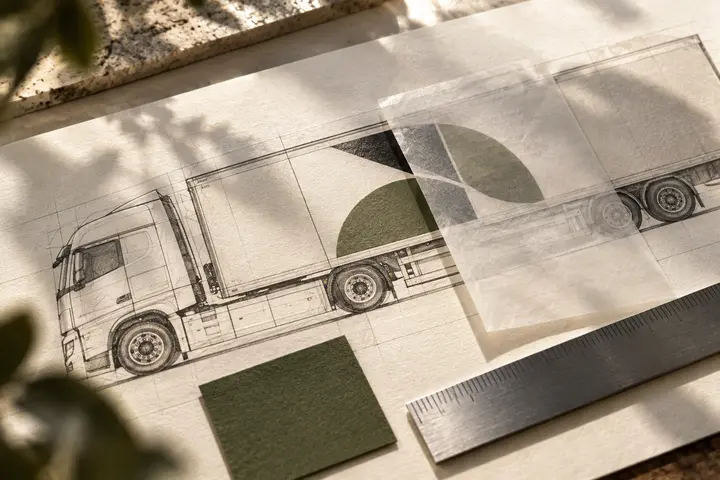
A raised panel, fixing point or curve can affect logo positioning. Mark the usable area on actual machine photographs rather than placing the name on an empty part of a drawing. The production supplier can provide a sample of the selected decal or plate method. When body colour resembles the brand colour, a version with a supporting background may be needed. These checks concern visual identity applications; they do not evaluate the machinery's engineering operation.
Keep model names from competing with the company
Imagine a company offering two machines under different model codes. If each code receives unrelated lettering and a large frame, the company signature can disappear between them. Show the two bodies together to define the model-name area's limits. Adding another model should not require redrawing the corporate identity. The designation salespeople use should be easy to locate in the catalogue heading. Testing both a short and a long model name within the same arrangement makes this decision easier to assess.
Small parts boxes provide a different test
The identity may also appear on spare-parts boxes, service folders or small labels. The scale available on a machine's side is impossible here. Consider a simpler application version if fine detail disappears, while preserving recognition of the same brand. Keep part codes in a separate information field instead of incorporating them into the logo. Review the box closed and the label filled with realistic information. Empty areas in a presentation should not conceal a later conflict between actual content and the identity.
Separate application drawings from the master mark
Name the corporate masters, model-lettering rules, dealer-board example and selected body applications separately at handover. An arrangement prepared for one machine should not be assumed to fit every other body. Ask quotations to state how many body examples and model names are included. Agree who approves visual adaptations made by the body supplier. A catalogue cover differs from a completed product page; if a full catalogue is expected, discuss that page scope explicitly. Approved model arrangements can then guide later applications.
Key takeaways
- Explain the company's role and relationships with other brands.
- Keep model designations separate from the permanent company mark.
- Approve a body application alongside a small parts label.
Frequently asked questions
Does every machine need a different logo?
A model change alone does not require a new corporate identity. A consistent model-name field can distinguish products while retaining the manufacturer's or dealer's master brand.
Can a representative image replace an actual machine photograph?
It can support an early direction discussion, but final approval should show the real body's usable area. Curves and fixing points may change the arrangement.
Is a dealer board included in the logo price?
List it explicitly. Other manufacturers' identities, board dimensions and editable production artwork introduce application work beyond the master logo.