In this article
When an old logo survives only as a small JPG, saving a larger copy does not restore lost drawing information. Search for usable artwork before deciding what must be reconstructed. Unlike a general guide to file formats, this article focuses on recovering a damaged mark through a controlled process. The objective is to preserve the approved identity in a reliable master, not to redesign it unintentionally.
Quick answer
Check old PDFs, production files and the designer’s archive first. If usable artwork cannot be recovered, choose automatic tracing or manual reconstruction according to the mark. Compare lettering, spaces and monochrome appearance against the reference. A PDF or SVG filename alone does not establish that the content contains editable vector paths. Verify the actual structure before treating it as a production master.
Search for sources before redrawing
A former printer, sign maker or web team may retain better artwork. One PDF can contain vector paths while another merely wraps a small bitmap. Have the contents inspected in suitable software and search dated email attachments and delivery folders. If versions differ, the brand’s decision owner should identify the approved design. The sharpest-looking file is not automatically the correct version.
Identify the kind of image damage
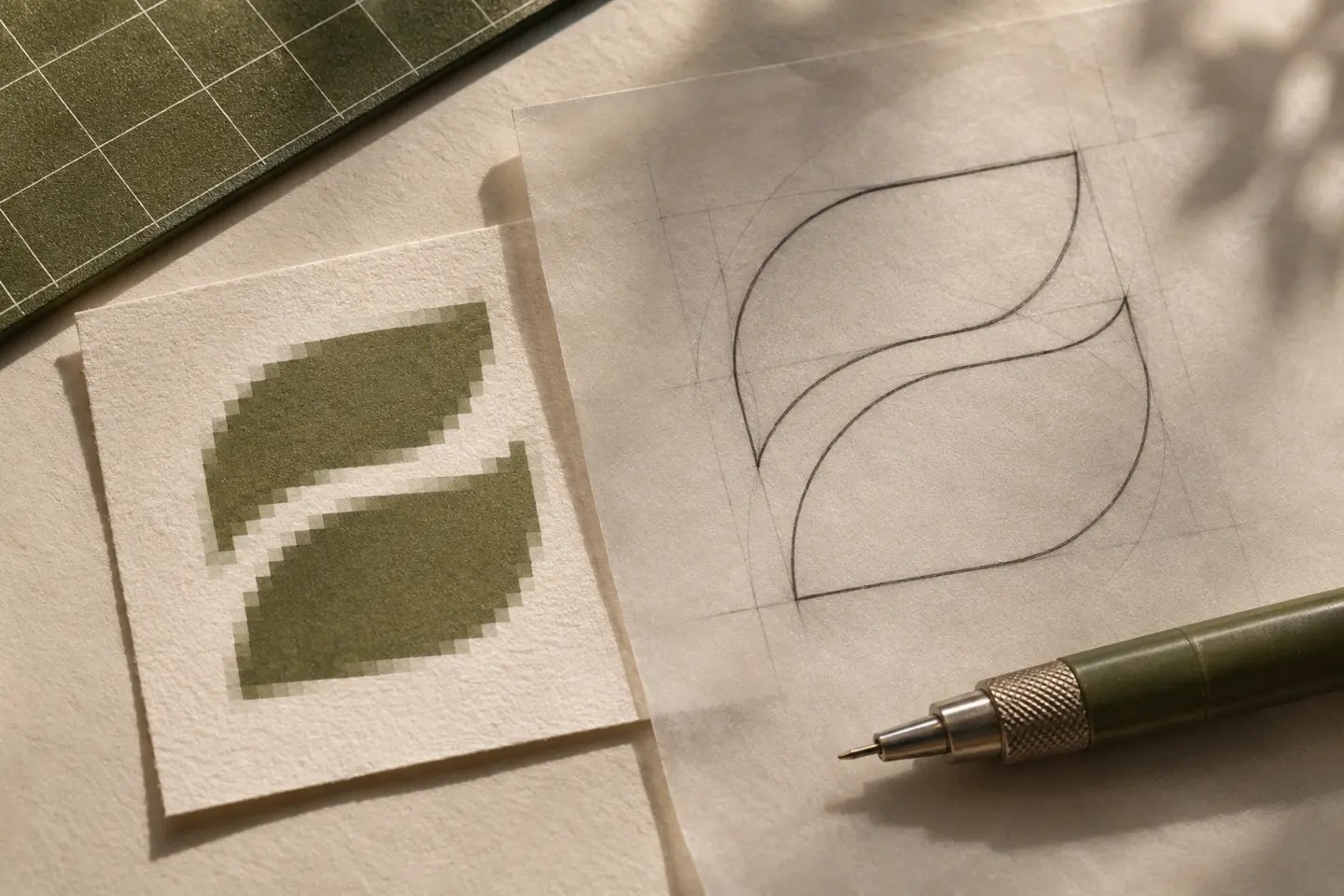
Pixel steps, compression artifacts, soft edges and an unwanted background are different problems. A pale fringe around a dark shape may not belong to the original drawing. A photograph may also introduce perspective distortion. Record uncertainties before reconstruction. Recovering every letter detail from a tiny product print may be impossible; areas requiring interpretation should be identified and approved rather than silently invented.
Treat automatic tracing as a starting point
Adobe Illustrator’s Image Trace provides options for converting raster artwork into vector graphics. Results depend on the source and settings. A simple black mark can provide a useful starting point, while damaged small lettering may produce excessive points or uneven edges. Review at several sizes. Inspect redundant shapes and closed spaces instead of accepting the traced output unchanged as the final production artwork.
Preserve character during manual reconstruction
Substituting a roughly similar font can unintentionally change the mark’s character. Compare custom terminals, spacing and the relationship to the symbol against the reference. Show uncertain features to the approval owner instead of assuming they are errors. Clean curves do not require unnecessary nodes. An overlay comparison with the original can reveal differences more clearly than judging general resemblance alone.
Review delivery in three applications
Test reconstructed artwork on a small screen, in a larger production example and in monochrome. Record the source of colour values rather than claiming a poor photograph establishes exact corporate colours. Keep the master, screen exports and approval record separate. A hypothetical service business may send vectors to a vehicle supplier while office staff use transparent PNGs. Explain each file’s intended role in the delivery note.
Key takeaways
- Search for approved source artwork first.
- Compare tracing against the reference.
- Separate master artwork from application exports.
Frequently asked questions
Is saving a JPG as PDF sufficient?
The container can change while the image remains the same raster data. Check whether editable paths and shapes are present. A different extension should not be treated as proof of vector artwork.
Can every logo be converted automatically?
Sources vary greatly. Small lettering, shadows and damaged edges may need interpretation or manual correction. Make a trial first and assess the result in its intended application rather than assuming automatic conversion is sufficient.
Is reconstruction the same as redesign?
When the approved form is retained, the objective is recovery. New decisions about lettering, proportions or symbols can move the work towards redesign. Agree that distinction in writing before reconstruction begins.