In this article
Corporate logo design develops a visual mark that represents a company consistently across its points of contact. The logo on a quotation and the sign at a production facility should belong to the same recognisable organisation. Documents prepared by procurement should not feel disconnected from the company’s social accounts. The task therefore goes beyond choosing a drawing that receives approval in a meeting. It is about establishing criteria for a design that teams and suppliers can apply correctly over time.
Quick answer
Corporate logo design translates a company’s activity, positioning and audience into a recognisable, usable and consistent visual mark. A complete process includes a clear brief, reasoned design directions, realistic application tests and usage guidance. The logo is a central component of corporate identity, but it does not replace the wider system of colours, typography, layouts and branded applications.
Separate the logo from the wider corporate identity
A logo is the symbol, lettering arrangement or combination that identifies a company. Corporate identity is the wider visual system built around it, including colour, typography, document layouts and application rules. Receiving a new logo does not automatically update every presentation or printed item used across a business.
Agree on the scope before development begins. Is the commission limited to the main logo, or does it include letterhead, presentation templates, email signatures and signage artwork? Separating those tasks makes expectations clearer and prevents unnecessary deliverables from complicating the main design decision.
Do not try to illustrate every company activity
Businesses with several services sometimes ask for a symbol representing each activity within one mark. That can create unnecessary complexity. Start with the quality customers should remember about the company. A shared approach may provide a more useful design direction than a collection of product illustrations.
Explain the relationship between the company name, subsidiaries and sub-brands in the brief. If new business areas may be added under the same parent name, discuss how the proposed structure could accommodate them. However, do not sacrifice present-day legibility to solve every uncertain future scenario.
Assess every direction against shared criteria
Set evaluation criteria before the presentation. Instead of asking for a design to feel stronger, explain what is missing in a specific application. Applying the same questions to every direction helps prevent a review from becoming a discussion of personal preferences alone. These criteria support a decision together; no single test establishes the final answer.
| Criterion | Question | Example test |
|---|---|---|
| Distinctiveness | Does the mark differ from relevant competitors? | Plain logos compared side by side |
| Legibility | Can users read the company name at the required size? | Document header and small screen |
| Practical use | Does it work with necessary production methods? | Single-colour print and signage sample |
| Consistency | Can different teams follow the same arrangement? | Presentation and quotation template |
Test realistic applications before approval
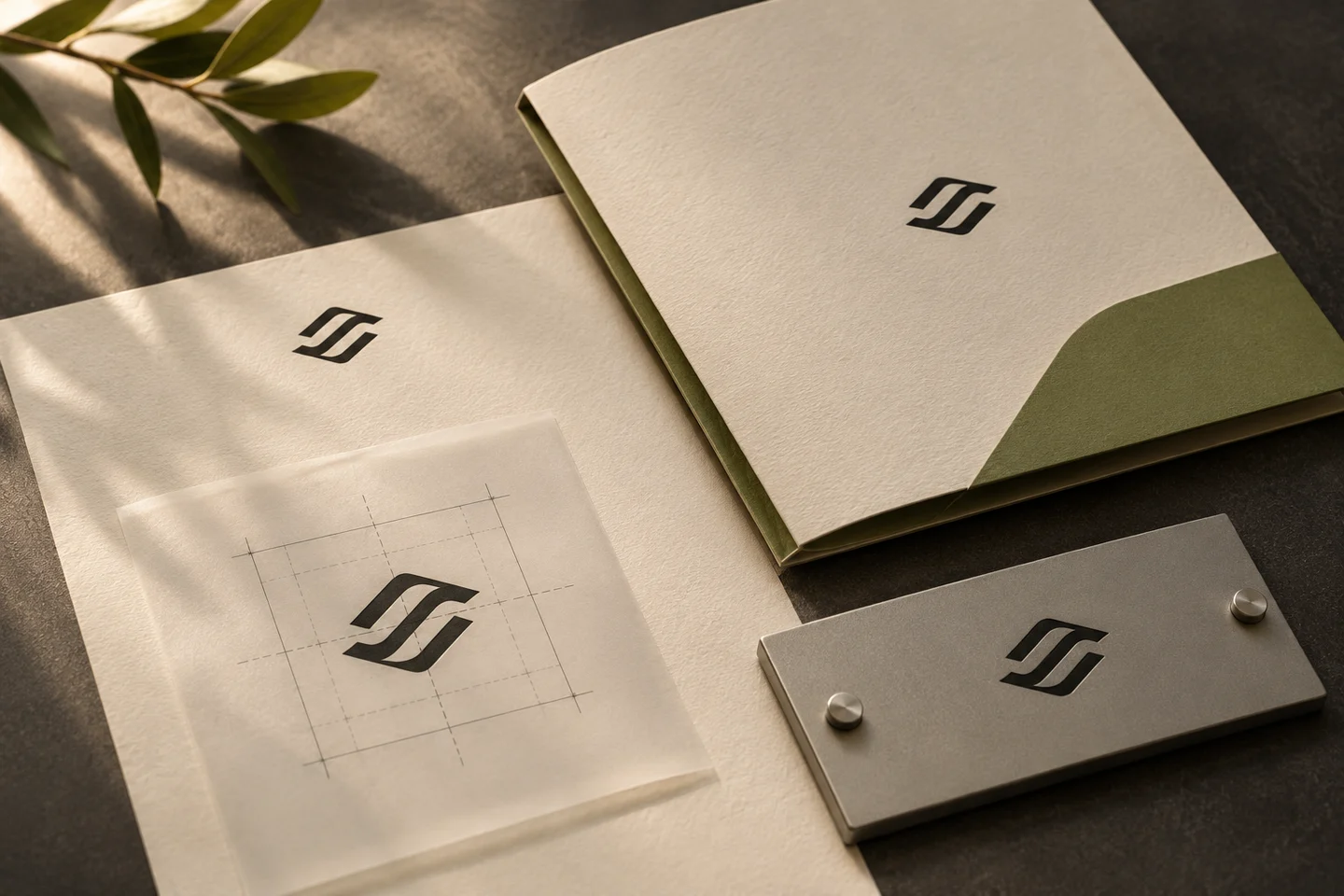
Consider a hypothetical manufacturing company. Sales uses its logo in quotations, human resources on identification cards, and site teams on workwear. A fine detail that looks impressive on a large monitor may disappear in a small print or embroidery. Support approval with samples close to the actual dimensions and production conditions.
Ask suppliers about their limitations before setting final line weights or minimum sizes. Assess dark backgrounds, one-colour use, horizontal areas and narrow spaces separately. Rather than inventing a different identity for each surface, prepare the necessary controlled alternatives of the same design.
- Check the company name in a realistic quotation header.
- Request production feedback for signs and workwear.
- Review a social account icon at its actual small display size.
Consolidate revisions through one project contact
Separate comments from many stakeholders can pull a design in incompatible directions. Nominate a company project contact to collect feedback, resolve priorities with the approver and send a consolidated response. Conflicting requirements then become issues to discuss rather than instructions the designer must attempt to follow simultaneously.
Describe the problem, its location and the intended result. For example, saying the company name is difficult to read in a document header leaves more useful solutions open than simply requesting a larger logo. Clarify revision scope, changes to the commission and approval stages during the quotation discussion.
Deliver usable files with concise application guidance
The main arrangement, required alternatives, one-colour versions, colour definitions and file names should form a coherent package. Explain which file belongs to which task. A large folder of vaguely named exports can cause people to use an outdated version even when the design itself is well resolved.
Our Corporate Identity Guidelines article explores usage rules in more detail. When introducing the new logo, agree which documents should change first, archive older versions and keep approved artwork accessible in a shared location. To discuss a project with BOCW, share your existing logo, priority applications and reasons for a change through the quote form.
Key takeaways
- Define logo development and wider identity applications as separate deliverables.
- Compare directions using shared criteria and realistic applications.
- Distribute approved files from one source and share usage rules with teams.
Frequently asked questions
What makes a suitable corporate logo?
It should reflect the company’s positioning, be recognisable and work on the required surfaces. No colour or symbol is compulsory for every business in a sector. Judge suitability through the brief and application tests.
How long does corporate logo design take?
The schedule depends on research, design directions, revisions and internal approvals. Request a project timetable covering meetings, presentations, feedback and delivery rather than assuming a fixed duration.
How is a corporate logo project priced?
Pricing reflects the existing brand, research scope, design directions, revisions and deliverables. Compare proposals using the same delivery list. Ask separately whether corporate identity applications are included in the logo commission.
Should an existing logo be refined or replaced?
Review recognition, practical problems and changing company requirements together. A limited issue may suit a controlled refinement, while new positioning may justify a wider redesign. The age of the logo alone should not decide the approach.