
In this article
At a butcher’s counter, the business name competes with product names and prices. Commissioning a logo means giving that signature a clear role inside a dense information environment. Begin with how the shop operates: a neighbourhood retailer, a seller of prepared products or a supplier to restaurants. Choosing an animal or knife illustration comes later. Counter labels and the main sign do not need identical levels of detail. The objective is an identity that can be repeated through the actual sales process without overshadowing the information customers need to choose products.
Quick answer
For a butcher shop logo, separate the permanent business signature from product descriptions, origin statements and temporary prices. Test the design on the shopfront, single colour wrapping paper, an apron and a small order image. Review fine details at actual print size. State whether label templates and packaging layouts are included, so logo files are not mistaken for a complete set of retail materials.
Do not let one animal define the entire range
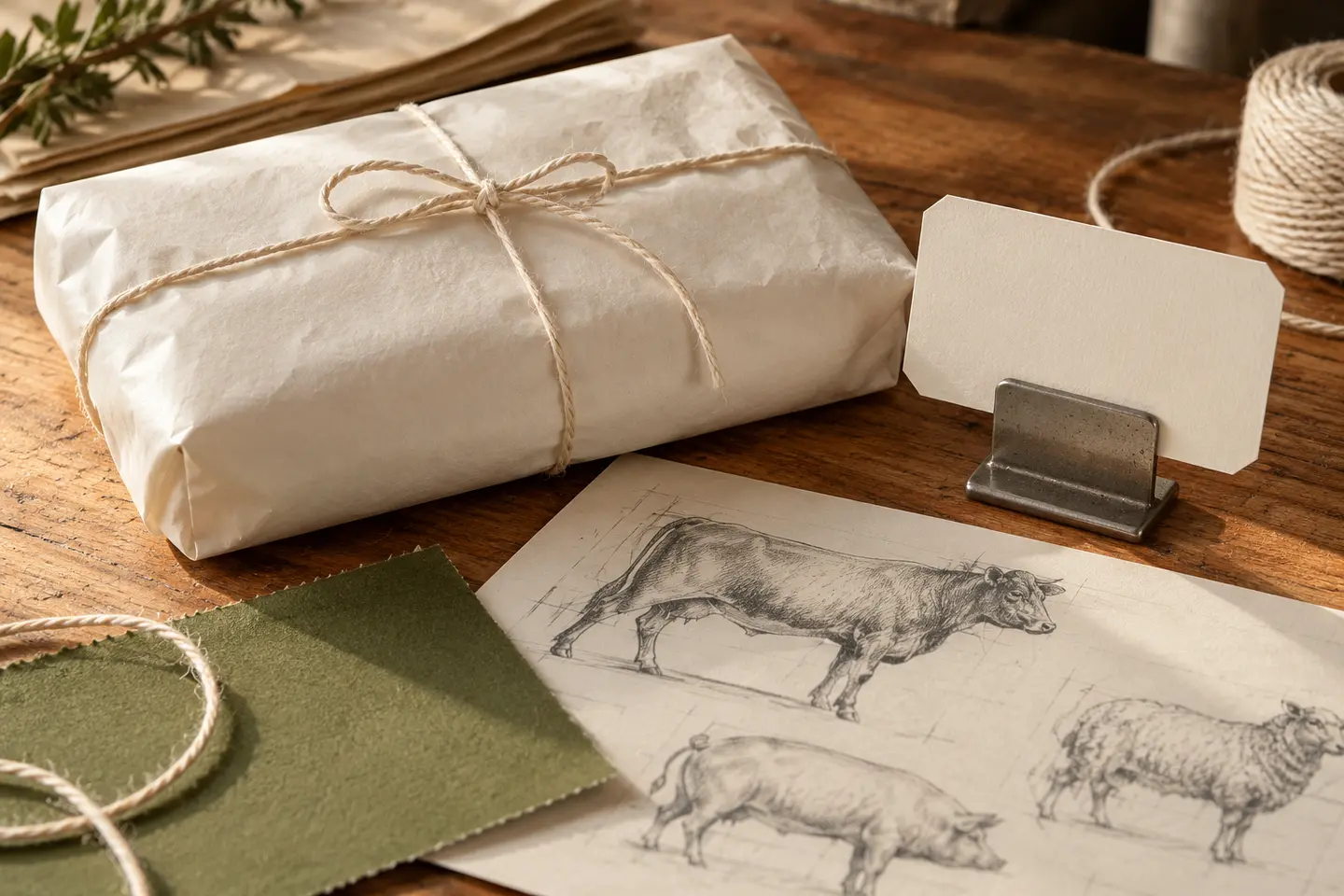
A cattle silhouette might communicate quickly, but it can narrow the impression of a shop also offering poultry, deli items or prepared cooking products. List the current range in the brief and include only firm expansion plans. Ask the designer to explain how illustrated and lettering led directions accommodate that range. The decision should concern the shop’s own recognizable name, rather than the fastest available industry shorthand. A strong category cue can be useful, but it needs to earn its place in the particular business.
Rehearse the competition between names and prices
Review the sign beside promotional notices, opening hours and existing window lettering. In a hypothetical shop, a weekend offer poster might hang directly beneath the name. If the offer visually overwhelms the identity, increasing the logo may not solve the underlying layout problem. Establish whether the commission includes only the mark or also a shopfront information arrangement. This makes the scope more concrete and reduces the amount of identity design left to be improvised by the signage contractor during installation.
Stress the detail on wrapping and small labels
A repeated mark on wrapping paper behaves differently from a large shop sign. Thin adjacent lines may merge in a print sample, and a long name can become cramped on a small label. Send the selected printer a trial at the intended dimensions. Use business approved product descriptions around the logo. Identity design should not be assumed to create specialist label content. The designer can allocate and organize the visual space while the business retains responsibility for supplying and approving the information itself.
Allow retail and wholesale materials different emphasis
A quotation sent to a restaurant has a different purpose from a customer carrier bag, yet they can remain recognizably related. Share the customer groups and ordering channels in the brief. Telephone orders, messaging based purchases and business quotations may need different scales of signature. Pay particular attention to marks added over product photographs. An oversized stamp can conceal the cut or package contents the customer is trying to inspect. Try a restrained corner signature before making the logo the dominant element in every image.
Finish with examples a printer can actually use
At approval, inspect a single colour mark, a reversed version, a small label arrangement and an apron application. If label design was purchased, request an example showing the editable product name area. An explicitly hypothetical meatball pack can test whether a longer description and the business signature fit together. Record the intended dimensions, paper choice and printing method in the handover notes. Those decisions help later production orders remain consistent, while making clear which applications have been resolved and which still require separate artwork.
Key takeaways
- Avoid narrowing a broad product range to one animal.
- Include price notices in the shopfront review.
- Assign responsibility for product label copy explicitly.
Frequently asked questions
Must a butcher logo include a knife?
No. Knife illustrations, animal symbols and lettering based identities can all be considered. The chosen direction should relate meaningfully to the shop name and range.
Should wrapping paper be commissioned too?
It is useful when wrapping is a frequent customer contact. A repeat pattern is an application of the identity and should be identified separately in the quote.
Does the designer verify product information?
The business should supply approved copy. A logo commission does not automatically include checking descriptions or label information that requires specialist review.

